


Marian University Student Outcome Measures
- Freshmen Fall to Fall Retention
- Graduation Rates
- Licensure Rates for Select Programs
- Career Outcome Measures
Freshmen Fall to Fall Retention
Fall to Fall Retention Goal: Marian University seeks to meet or exceed the FTFT Fall to Fall five-year rolling average based on IPEDS Data. The six-year average for 24-25 is 66%.
Marian University is dedicated toward improving freshman fall to fall retention in a variety of ways. The institution understands that freshman retention in the first academic year is vital to student success and implements multiple initiatives to assist students and transitioning from freshman to sophomores.
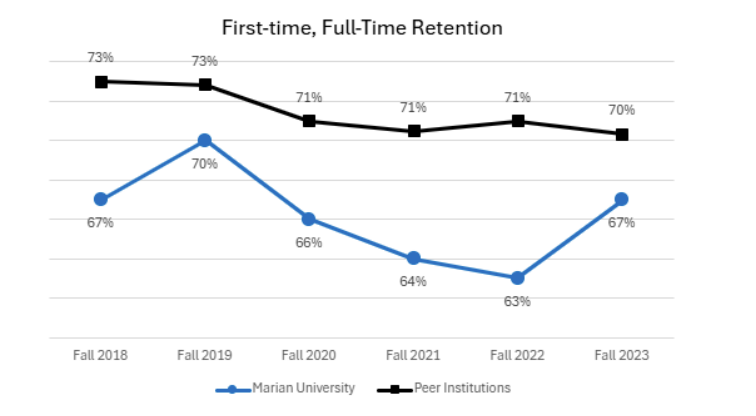
Marian University has two retention groups that facilitate and coordinate retention strategies and efforts, the Retention Intervention Team and the Retention Strategies Committee.
The Retention Intervention Team is comprised of representation from Residence Life, Athletics, Financial Aid, Student Success, and the Business Office. This team directly works with students, following up when concerns are brought forward, primarily with financial, balances, and intentions of returning for the next term. They work directly with students of concern by communicating with Marian staff (i.e. RAs, Hall Directors, Advisors, Coaches, etc) to make contact with students to check-in, gather information, provide resources, and be a level of support. The team uses connections and affinities that have been documented to provide assistance for the concerned students. The team meets monthly in the beginning of the semester, but after the registration period, they meet bi-weekly to follow up with students not registered. The full intention of the group is to determine likelihood of students to register.
The Retention Strategies Committee consists of representation from Admission, Athletics, Business Office, Faculty, Financial Aid, Registrar, Residence Life, Student Life, Student Success, and TRIO. The propose of the Retention Strategies is to proactively identify, develop, implement, and assess wide-ranging initiatives and strategies aimed at promoting and fostering student progression and graduation. By collaborating with a variety of campus-wide departments, the group strives to create and support inclusive environments that address the diverse needs of Marian students, promote student engagement, enhance academic advising and support, and effectively use data-driven strategies to identify at-risk students and provide timely interventions. By continuously evaluating and refining our retention efforts, the committee aims to improve and maximize student retention rates, which ultimately contributes to overall student success and satisfaction.
Both groups are facilitated by the Dean of Student Success.
Graduation Rates
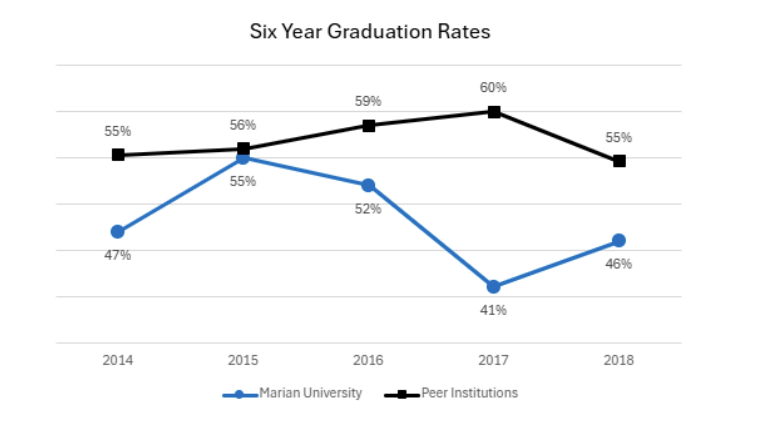
Graduation Rate Goal: Marian University seeks to meet or exceed the five year average of Graduation Rates, based on IPEDS Data.
Marian University has two retention groups that facilitate and coordinate retention strategies and efforts, the Retention Intervention Team and the Retention Strategies Committee.
The Retention Intervention Team is comprised of representation from Residence Life, Athletics, Financial Aid, Student Success, and the Business Office. This team directly works with students, following up when concerns are brought forward, primarily with financial, balances, and intentions of returning for the next term. They work directly with students of concern by communicating with Marian staff (i.e. RAs, Hall Directors, Advisors, Coaches, etc) to make contact with students to check-in, gather information, provide resources, and be a level of support. The team uses connections and affinities that have been documented to provide assistance for the concerned students. The team meets monthly in the beginning of the semester, but after the registration period, they meet bi-weekly to follow up with students not registered. The full intention of the group is to determine likelihood of students to register.
The Retention Strategies Committee consists of representation from Admission, Athletics, Business Office, Faculty, Financial Aid, Registrar, Residence Life, Student Life, Student Success, and TRIO. The propose of the Retention Strategies is to proactively identify, develop, implement, and assess wide-ranging initiatives and strategies aimed at promoting and fostering student progression and graduation. By collaborating with a variety of campus-wide departments, the group strives to create and support inclusive environments that address the diverse needs of Marian students, promote student engagement, enhance academic advising and support, and effectively use data-driven strategies to identify at-risk students and provide timely interventions. By continuously evaluating and refining our retention efforts, the committee aims to improve and maximize student retention rates, which ultimately contributes to overall student success and satisfaction. Both groups are facilitated by the Dean of Student Success.
Licensure for Programs
Select programs at Marian University may require students to be licensed by outside boards. Those programs include:
Nursing, Family Nurse Practitioner, Radiology Technology
Nursing
Licensure Pass Rates BSN
| Year | Rate % |
|---|---|
| 2021 | 100% |
| 2022 | 96.67% |
| 2023 | 96.30% |
Family Nurse Practitioner Certification Pass Rates
| Year | Average % |
|---|---|
| 2020 | 88% |
| 2021 | 94% |
| 2022 | 85% |
All nursing programs have a licensure/certification benchmark of 80%. In order to assist students in passing the licensure exam, students take a licensure prep course where students are practicing NCLEX-RN (National Council Licensure Exam) type questions and taking standardized outcome tests to determine areas of strength and weakness, and remediating areas of weakness. For aggregate areas of weakness, the program brings in an expert to do a review on that content.
The program also teaches them about what categories of content are on the NCLEX exam and what is included in the testing process to help reduce any test anxiety. Finally, the program helps them register for the exam and fill out their application for licensure.
Included in the prep course, is a 3 day professional review. The faculty and staff support their efforts during this 3 day weekend course by providing food and a relaxing environment for them to focus on their learning and know that the nursing department supports them in any way we can.
Radiology Technology
The Radiologic Technology Program continues to achieve a first-time pass rate of 100% on the American Registry of Radiologic Technologists (ARRT) national certification examination while the national average for the same five-year period is between 83-85%.
The Program’s benchmark for first time attempts on the examination is 80%.
The Program’s success on this examination is due to a multitude of factors:
- The minimum passing score on the examination is 75%. The Program requires that students obtain a minimum of 80% at the completion of each course.
- The Program has four Progression Examinations scheduled throughout the curriculum. Each exam covers material from the present back to the beginning of the Program. This ensures that students, throughout the duration of the Program, will be required to continue to review material from earlier in the Program. The Program has designed each examination to be as similar to the national examination as possible: 200 questions completed on the computer with the fourth having a 3-hour time limit. To improve each cohort’s success on each Progression Exam, faculty lead review sessions, with required attendance, are scheduled weeks leading up the respective exam.
- The RAD 476 Senior Capstone course, occurring Spring semester of senior year, prior to graduation and sitting for the certification examination, is dedicated to Faculty lead review sessions. Each course has 1-2 review sessions dedicated for reviewing the respective material.
- The Program recently incorporated the use on an online learning resource into the curriculum in addition to being heavily utilized during the RAD 476 course. Faculty assign assessment tests created by the resource throughout the curriculum. Faculty also have the ability to create their own assessment tests and assign them to the students during RAD 476.
National Certification Examination Pass Rates
| Year | Average % |
|---|---|
| 2021 | 100% |
| 2022 | 100% |
| 2023 | 100% |
| 2024 | 100% |
| 2025 | 100% |
National Certification Examination Mean Scores
Program Average vs. National Average
| Year | Program Average | National Average |
|---|---|---|
| 2021 | N/A (only 2 graduates) | 82.3% |
| 2022 | 91.6% | 82.4% |
| 2023 | 87.3% | 82% |
| 2024 | 87% | 82.9% |
| 2025 | 89.3% | N/A |
Career Outcome Measures
Marian University’s Career Services team supports student success by fostering strong participation in experiential learning opportunities that help students build professional skills and career readiness. Each year, students engage in internships, practicums, and clinical placements across a wide range of academic programs, with an institutional five‑year average of 181 students participating annually in these career‑focused experiences. These opportunities consistently involve roughly 15% of degree‑seeking undergraduates, reflecting Marian’s commitment to connecting classroom learning with hands‑on practice. By partnering closely with faculty, employers, and community organizations, Career Services ensures students have access to meaningful applied learning experiences that enhance career exploration, strengthen résumés, and support successful post‑graduation outcomes.
In addition to strong annual participation rates, Marian University is proud to report that 100% of graduating undergraduate students complete at least one form of work‑based learning prior to graduation, ensuring every student gains meaningful real‑world experience related to their field of study. This requirement is fulfilled through internships, practicums, clinical placements, or other approved experiential opportunities, all of which are supported and coordinated through Career Services in collaboration with academic programs. By embedding applied learning into every undergraduate pathway, Marian ensures that graduates enter the workforce with practical skills, professional exposure, and a competitive advantage in their chosen careers.
Students Participating in Experiential Learning Opportunities
| 20-21 | 21-22 | 22-23 | 23-24 | 24-25 | Five Year Average | |
|---|---|---|---|---|---|---|
| Internship | 97 | 83 | 110 | 99 | 104 | 99 |
| Practicum | 20 | 46 | 47 | 50 | 25 | 38 |
| Clinical | 73 | 48 | 46 | 30 | 26 | 45 |
| Total Participants | 190 | 177 | 203 | 179 | 155 | 181 |
| Total Degree Seeking Undergraduates | 1448 | 1323 | 1247 | 1147 | 1037 | 1240 |
| Percentage of Participation | 13.1% | 13.4% | 16.3% | 15.6% | 14.9% | 14.7% |
Appendix
Table __
Retention Data
First-Time, Full-Time Retention Rates
| Fall 2018 | Fall 2019 | Fall 2020 | Fall 2021 | Fall 2022 | Fall 2023 | Six Year Average | |
|---|---|---|---|---|---|---|---|
| Marian University | 67% | 70% | 66% | 64% | 63% | 67% | 66% |
| Peer Institutions | 73% | 73% | 71% | 71% | 71% | 70% | 71% |
Note: All Retention rate data is from the Fall Enrollment portion of IPEDS, and peer institutions include the following institutions: Alverno College, Carthage College, Edgewood University, Lakeland University, Mount Mary University, and Viterbo University.
Table __
Graduation Rates Data
Graduation Rates
| Institution | Type of Graduation Rate | 2014 | 2015 | 2016 | 2017 | 2018 | Five Year Average |
|---|---|---|---|---|---|---|---|
| Marian University | Four Year Graduation Rate | 35% | 44% | 39% | 30% | 33% | 36% |
| Marian University | Five Year Graduation Rate | 43% | 54% | 51% | 40% | 45% | 47% |
| Marian University | Six Year Graduation Rate | 47% | 55% | 52% | 41% | 46% | 48% |
| Peer Institutions | Four Year Graduation Rate | 41% | 42% | 46% | 48% | 43% | 44% |
| Peer Institutions | Five Year Graduation Rate | 54% | 53% | 57% | 59% | 53% | 55% |
| Peer Institutions | Six Year Graduation Rate | 55% | 56% | 59% | 60% | 55% | 57% |
Note: Graduation rate data for peer institutions is from IPEDS and includes the following institutions: Alverno College, Carthage College, Edgewood University, Lakeland University, Mount Mary University, and Viterbo University.
Table __
Marian University: Graduation Rates Data by Pell vs Non-Pell
| Type of Graduation Rate | 2012 | 2013 | 2014 | 2015 | 2016 | Five Year Average | |
|---|---|---|---|---|---|---|---|
| Pell | Four Year Graduation Rate | 26% | 26% | 29% | 31% | 32% | 29% |
| Pell | Six Year Graduation Rate | 39% | 40% | 39% | 40% | 43% | 40% |
| Pell | Eight Year Graduation Rate | 40% | 40% | 40% | 40% | 44% | 41% |
| Non-Pell | Four Year Graduation Rate | 41% | 54% | 45% | 49% | 42% | 46% |
| Non-Pell | Six Year Graduation Rate | 62% | 66% | 53% | 63% | 57% | 60% |
| Non-Pell | Eight Year Graduation Rate | 64% | 67% | 54% | 64% | 58% | 61% |
Note: Marian University graduation rate data broken down by Pell vs Non-Pell is found in the Outcome Measures portion of IPEDS.
Table __
Peer Institutions: Graduation Rates Data by Pell vs Non-Pell
| Type of Graduation Rate | 2012 | 2013 | 2014 | 2015 | 2016 | Five Year Average | |
|---|---|---|---|---|---|---|---|
| Pell | Four Year Graduation Rate | 31% | 34% | 31% | 36% | 38% | 34% |
| Pell | Six Year Graduation Rate | 46% | 48% | 47% | 50% | 50% | 48% |
| Pell | Eight Year Graduation Rate | 48% | 50% | 48% | 51% | 51% | 49% |
| Non-Pell | Four Year Graduation Rate | 47% | 48% | 47% | 43% | 51% | 47% |
| Non-Pell | Six Year Graduation Rate | 60% | 64% | 62% | 59% | 63% | 62% |
| Non-Pell | Eight Year Graduation Rate | 61% | 66% | 63% | 60% | 64% | 63% |
Note: Graduation rate data for peer institutions is found in the Outcome Measures portion of IPEDS. and includes the following institutions: Alverno College, Carthage College, Edgewood University, Lakeland University, Mount Mary University, and Viterbo University.

